Tagged: pensions

Pages

Politics
10:27 am
Thu September 8, 2011

The Michigan Supreme Court and the Pension Tax

The Michigan Supreme Court will soon issue an opinion on whether the new law taxing pensions is constitutional.

If they say it is, it’s full speed ahead for the governor’s plan. If they decided that taxing pensions is not constitutional, it’ll knock a huge hole in the budget. That means the state will have to get more revenue -- which means raising taxes.

That, or roll back the business tax cuts or slash aid to education and other programs more severely than ever.

And while I don’t pretend to know exactly what would happen, I can tell you this, after talking to the governor last week. He isn’t about to roll back the tax cuts, and he doesn’t want to raise taxes.

Read more
Politics
7:47 am
Wed September 7, 2011

Mich. Supreme Court to hear pension tax arguments

Credit Subterranean / Wikipedia Commons
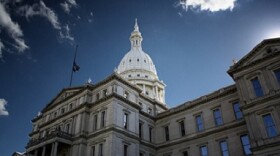
State Supreme Court building, Lansing, Michigan

Scores of seniors upset the state will tax some of their public pensions for the first time are expected to pack the courtroom when the Michigan Supreme Court hears oral arguments on the law.

The hearing begins Wednesday morning in the Hall of Justice.

The case is a major test of sweeping tax changes put in place earlier this year by Republican Gov. Rick Snyder.

He wants a Supreme Court advisory opinion that would effectively pre-empt any court challenge on the law filed by opponents such as public employee unions, who say the state constitution protects their pensions from being taxed.

Starting Jan. 1, pensions and some retirement income that previously was partially exempt would be taxed as regular income for those born after 1945.

Read more
Politics
11:43 am
Fri September 2, 2011

Fairness of pension tax will be decided by Michigan Supreme Court

Credit user subterranean / wikimedia commons
The Michigan Hall of Justice - where the Michigan Supreme Court sits. Justices will decide on the fairness of the new tax on pensions.

The Michigan Supreme Court has agreed to let unions and business groups weigh in before the justices rule on whether the state’s new tax on pension income is legal.

The court will hear arguments in the case next week.

Governor Rick Snyder asked the court to cut short any legal challenges with a preemptive ruling.

The governor wants an opinion from the court before the end of the month.

His budget relies on $343 million dollars from taxing pensions, and he wants to avoid months or years of legal wrangling on the question.

The governor asked the court to decide whether the pension tax breaks a promise by the state to retirees and public employees; and whether income limits in the law amount to a graduated income tax – which is prohibited by the state constitution.

The Supreme Court has agreed to accept briefs from retiree associations and unions that oppose the pension tax, as well as business groups that say the tax is fair.

The Michigan Education Association, the UAW, and the AARP are among the groups that filed briefs opposing the tax. They say the pension tax breaks a promise to retirees and public employees, and it violates the state constitution.

Business groups, including the Michigan Bankers Association, and the Small Business Association of Michigan, are backing Governor Rick Snyder. They say the pension tax is fair because it treats all income equally in the tax code.

If the pension tax is upheld, pension income will be subject to the state income tax starting January 1, 2012.

Politics
8:30 am
Thu June 16, 2011

Michigan Supreme Court agrees to decide pension tax question

Credit Michigan Supreme Court
The Michigan Supreme Court has agreed to take up the question of taxing pensions.

The state Supreme Court has agreed to Governor Rick Snyder’s request to make an early ruling on whether the new income tax on pensions violates the Michigan Constitution.

Governor Snyder made the request to avoid what potentially could be years of litigation.

The governor is trying to preempt an expected lawsuit from state employee unions. They say the tax on pensions will illegally reduce their agreed-to compensation under collective bargaining agreements.

The Michigan Constitution says the state may not “diminish” nor “impair” the financial benefits of pension plans.

The governor wants the question settled before the pension tax takes effect next year. The law extends the state income tax for the first time to pensions of people born after 1945.

The Supreme Court ordered oral arguments to be held in the case in September. The court has a Republican majority.

Politics
5:17 pm
Thu April 28, 2011

Governor Snyder's tax overhaul plan passes the House

Credit Lester Graham / Michigan Radio
Governor Snyder's tax plan has passed the State House.

Update 5:14 p.m.

Governor Rick Snyder’s tax overhaul plan began working its way through the Legislature today as it cleared the state House by a mostly party-line vote.

The Republican tax reform bill would replace the complex and unpopular Michigan Business Tax with a corporate profits tax.

Two-thirds of Michigan businesses would not have to pay the tax.

Part of the revenue lost to the state would be made up by eliminating dozens of tax breaks.

Many of them go to businesses and charities. Also gone would be earned income credit for working poor families and the income tax exemption for most seniors on pensions.

“This is a turnaround moment for Michigan,” said Republican House Speaker Jase Bolger. “Today’s winners are our local small business owners. Today’s winners are the unemployed because now those small business owners can create jobs.”

Democrats say it’s not fair to make working families and seniors make up the difference while most businesses pay less. Democratic state Representative Barb Byrum says it's not a fair trade.

“This legislation is not a shared sacrifice and should not be adopted. Today is just another day another day to give an 82% tax break to wealthy, corporate special interests. Another day to take from our children, our seniors, and our working poor."

The measure now goes to the Republican-controlled state Senate.

3:41 p.m.

Governor Rick Snyder’s tax overhaul plan has begun its march through the Legislature.

It won the approval of the state House by a mostly party-line vote.

The measure would scrap the complicated and unpopular Michigan Business Tax.

It would be replaced by a corporate income tax that would not be paid by two-thirds of the state’s businesses.

Part of that lost revenue would be made up by ending many tax breaks for businesses, working poor families, and seniors on pensions.

Politics
3:42 pm
Tue April 12, 2011

Govenor Snyder and Republican leadership getting closer on budget deal

Credit Lester Graham / Michigan Radio
Republican leaders in the state legislature are getting closer to a deal on the budget.

Governor Rick Snyder and Republican leadership in the State House and Senate appear to be close to a deal on the budget.

From the Associated Press:

Gov. Rick Snyder and Republican state lawmakers are reporting "significant progress" on proposals related to business and pension taxes for the fiscal year starting in October...

Two people with knowledge of the talks tell The Associated Press that the proposals include many elements of Snyder's original business tax plan. They spoke on the condition of anonymity because the deal hasn't been finalized.

The Republican governor wants to replace the state's main business tax with a 6 percent corporate tax applied to corporations with shareholders.

The plan would include taxes on pensions and other retiree income but it would be modified from Snyder's original proposal. The new proposal calls for phasing in or scaling back the tax.

Some lawmakers have been loathe to accept any taxes on pensions, but it appears a plan to phase in a pension tax may be more palatable.

Peter Luke of Booth Newspapers reports on some of the details of the agreement:

Under the phased-in alternative, the status quo would apply to those 67 and up, whose pensions would continue to be tax exempt.

A middle group of retirees 60 to 66 would be subject to a pension tax, but the first $20,000 of pension income for single filers -  $40,000 for joint filers - would be tax exempt.

Those younger than 60 would pay tax on all their pension income.

An AARP spokesman said they remain opposed to a tax on pensions, whether its phased in or not.

A public announcement of the agreement is expected to come this afternoon.

Pages