Tagged: wolves

Pages

Environment
10:36 am
Tue February 7, 2012

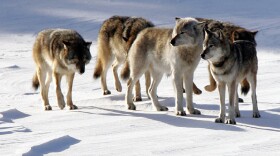
Living with Michigan's wolves

Credit Tracy Brooks/Mission Wolf/USFWS
Michigan's gray wolf population is estimated to be 687 animals. The recovery goal for the population is between 250-300 wolves.

Gray wolves in the western Great Lakes were recently taken off the endangered species list. Now, the state of Michigan is responsible for managing the wolf population.

Michael Nelson is a professor of environmental ethics at Michigan State University. He’s an author of a new report on people’s attitudes about wolves in Michigan. His report is based on a statewide telephone survey conducted in 2010. 

Nelson says they asked people throughout the state how they felt about the following four statements (on a five point scale from strongly disagree to strongly agree):

  1. "I enjoy knowing wolves exist in Michigan."
  2. "I would be likely to purchase a license to hunt or trap wolves."
  3. "The decision to hunt wolves should be made by public vote."
  4. "Wolves should only be hunted if biologists believe the wolf population can sustain a hunt."

Michael Nelson says overall, Michiganders tend to value wolves.

"Generally, we found out that people enjoy knowing there are wolves in Michigan. This varies from place to place. We also found out that in general, the people of Michigan really support wildlife biology, wildlife science as an important way to make decisions about wolves."

But he says people’s feelings about wolves change based on where they live in the state.

Read more
Environment
1:46 pm
Wed February 1, 2012

What life off of the Endangered Species List could mean for Michigan wolves

Credit user metassus / Flickr
The wolf population in Michigan is now being controlled by the state. In Minnesota, officials are considering a hunting season.

As of last Friday, wolves in Michigan are no longer a federally protected “endangered species.”

On December 21, 2011 Secretary of the Interior Ken Salazar announced in Washington that Gray wolf populations in the Western Great Lakes states of Minnesota, Michigan and Wisconsin have exceeded recovery goals and are stable enough to be removed from the Endangered Species List.

The current populations in each state are:

Read more
Environment
4:19 pm
Wed December 21, 2011

Great Lakes wolves to be taken off endangered species list

Credit USFWS Midwest
Canis lupus.

Update 4:19 p.m.

The U.S. Interior Department announced today gray wolf populations in the Great Lakes region have recovered and no longer require the protection of the Endangered Species Act.

They will lose their federal protection as of January 27, 2012.

From a U.S. Fish and Wildlife Service press release:

"Gray wolves are thriving in the Great Lakes region, and their successful recovery is a testament to the hard work of the Service and our state and local partners," said Fish and Wildlife Service Director Dan Ashe. "We are confident state and tribal wildlife managers in Michigan, Minnesota and Wisconsin will effectively manage healthy wolf populations now that federal protection is no longer needed."

The Associated Press reports that Michigan Department of Natural Resources Director Rodney Stokes says "the change will give state officials more flexibility to deal with problem wolves and make people more supportive of having the predators in their midst."

Wisconsin officials will issue permits allowing landowners to control "problem wolves" on their property.

11:25 a.m.

The wolf population in Michigan has been growing. Michigan DNR estimates put it at more than 650 animals for 2010-2011. The number was around 430 wolves in 2004-2005.

Wolves in the western Great Lakes region have been taken off the Endangered Species List before, and conservation groups have successfully sued the federal government to put them back on the list.

Now, the Associated Press reports western Great Lakes wolves will be delisted again.

From the AP:

The Obama administration is taking gray wolves in the western Great Lakes region off the federal endangered species list.

The Associated Press obtained a Wednesday statement in which Interior Secretary Ken Salazar says the more than 4,000 wolves in Michigan, Minnesota and Wisconsin have exceeded recovery goals and
no longer need federal protection.

Responsibility for managing and protecting those wolves will be turned over to state wildlife agencies. The populations will be monitored for at least five years to make sure they remain at sustainable levels.

The Interior Department also says it's reconsidering a previously announced plan to remove endangered species protections for wolves in 29 Eastern states, even though they aren't believed
to have any established wolf populations. Officials say they'll decide on the status of Eastern wolves later.

State officials say they're prepared for federal delisting. The state of Michigan has a wolf management plan.

Once management is turned over to the state, people would have more flexibility in killing "problem wolves." From Bob Allen's report on The Environment Report:

The plan would give people the authority to defend against attacks on their pets and livestock, and it would allow them to cull wolves in places where they’re putting a lot of pressure on deer.

The current state management plan does not call for a hunting season on wolves. It would take an act of the state legislature to make a hunt a reality.

Environment
3:39 pm
Thu August 25, 2011

Feds re-open comment period on gray wolf de-listing

Credit Christian Jansky / wikimedia commons
Does this wolf look any different to you? It's an Eastern Wolf; a separate species from the Gray Wolf. U.S. Fish and Wildlife Service officials say they're working to set the record straight on where these wolves historically ranged in the U.S.

Last May, the federal government proposed dropping gray wolves in the western Great Lakes region off the endangered species list... again.

The public  comment period on that proposal ended July 5, but now the federal agency in charge of the Endangered Species Act wants to open the comment period back up.

The reason? They want to get their scientific history right.

The federal government historically had the gray wolf ranging in 48 states.

But in all or parts of 29 eastern states there was actually a different wolf species - aptly named the "eastern wolf."

Scientists suspect the gray wolf species did not historically range in these 29 states.

In their proposal to de-list the gray wolf in the western Great Lakes region, the U.S. Fish and Wildlife Service also proposed to revise the range of the gray wolf, and to establish the range of the eastern wolf.

From a USFWS. press release:

the Service received significant comments from states and other stakeholders concerning North American wolf taxonomy. The Service is seeking all information, data, and comments from the public with respect to any new information relevant to the taxonomy of wolves in North America.

So if you want to weigh in on the taxonomic history of gray wolves and eastern wolves, you have 30 days to do so starting tomorrow.

Environment
2:51 pm
Thu July 14, 2011

Illegal wolf kills spiking in Michigan's Upper Peninsula

Credit Photo of wolves on Isle Royale / www.isleroyalewolf.org
In 1992, biologists counted 20 wolves in Michigan. The population has gone up since then and in 2010, 557 wolves were confirmed in the U.P.

No other wildlife species, it seems, causes such extremes of emotion as the wolf.

Some people want to protect it at any cost.

Others want to shoot the animal on sight.

And in Michigan’s Upper Peninsula illegal wolf kills are spiking.

Wildlife officials say they can defuse the situation if they can just get gray wolves removed from the endangered species list.

Interlochen Public Radio's Bob Allen filed a report with The Environment Report on the controversy in Michigan's Upper Peninsula.

Allen reported that the return of the gray wolf in the U.P. more than 20 years ago didn't cause concern, but that's changed in the last few years as some hunters are convinced wolves are decimating the white tail deer population.

Here's Allen's report:

Read more
Environment
12:27 pm
Thu June 2, 2011

DNR to hold wolf forum in Marquette

The federal government says gray wolves in the Great Lakes states are no longer endangered, and they can come off the endangered species list. If that happens, the state would be in charge of managing the wolves.

The Department of Natural Resources is holding a forum in Marquette tomorrow. The DNR’s inviting everyone from the farm bureau to conservation and hunting groups. The agency wants these groups to weigh in on the state’s wolf management plan.

Christopher Hoving is with the DNR. He says the plan would allow officials to shoot problem wolves. For example... if a wolf kills a cow or a sheep.

“It’s not something we like to do or want to do, but we can’t have that behavior of killing sheep be spread throughout the population.”

He says under the state plan, Michigan residents can also kill a wolf that’s attacking their livestock or pets.

Environment
11:03 am
Tue May 17, 2011

Congress to remove Michigan's gray wolves from endangered species list?

Credit Tracy Brooks/Mission Wolf/USFWS
Michigan's gray wolf population is estimated to be 687 animals. The recovery goal for the population is between 250-300 wolves.

At the moment, the federal government manages the gray wolf populations in Michigan, Minnesota and Wisconsin. But federal officials say the wolves in these states are doing great, and they want to hand management over to the states.

This isn’t the first time federal officials have tried to take wolves off the endangered species list. Wolves were delisted in 2007... but that delisting was challenged in court by some environmental groups. And wolves were put back on the list.

Some members of Congress are trying to make sure these kinds of lawsuits don’t happen again.

Candice Miller represents Michigan’s 10th district. It’s in the Thumb. She just introduced a bill that would amend the Endangered Species Act... and remove wolves from the list. Her bill would make it more difficult for anybody to sue over that decision.

“You have a number of anti-hunting groups and they constantly tie these decisions up in court. I think this legislation is a huge tool to be used so the courts don’t have these things happening.”

She says her office has been approached by sportsmen and farmers worried about wolves preying on deer, moose and livestock.

Michigan’s wolf management plan does not call for a hunting season for wolves. The state legislature would have to decide that.

Read more
Environment
5:16 pm
Wed May 4, 2011

Feds want states to manage wolves around the Great Lakes

Credit USFWS
The federal government wants to turn management of gray wolves in the western Great Lakes over to the states.

The U.S. Department of Interior's Fish and Wildlife Service today announced that it plans to remove the western Great Lakes gray wolf population from the Endangered Species list.

These are wolves found in Michigan, Wisconsin, Minnesota, and areas adjoining these states.

Acting Service Director Rowan Gould was quoted in today's press release:

“Gray wolves in the Western Great Lakes are recovered and no longer warrant protection under the Endangered Species Act. Under this proposed rule, which takes into account the latest taxonomic information about the species, we will return management of gray wolves in the Great Lakes to state wildlife professionals. We are confident that wolves will continue to thrive under the approved state management plans.”

There will be a sixty-day comment period before the rule is finalized.

Mary Detloff, a spokesperson for the Michigan Department of Natural Resources, says the state supports the decision and is ready to take over management of the species:

"The most recent estimate that we have of the minimum winter population for wolves in Michigan is around 687 animals which far exceeds our recovery goal here in the state. Our recovery goal was around 200-300 wolves."

Detloff says delisting the wolf would allow the state to deal with problem wolves.

Read more
Environment
12:42 pm
Thu April 7, 2011

Isle Royale's wolves to go extinct?

Credit Photo courtesy of isleroyalewolf.org
Wolves on Isle Royale in Lake Superior

The wolves of Isle Royale National Park in Lake Superior could be in trouble.

For 53 years, researchers from Michigan Tech have been studying the island’s wolf and moose populations.

This year... they found there are fewer wolves – just 16. And only a couple of females that can still have babies. Rolf Peterson has been studying the wolves for more than four decades.

He says it's not clear why some of the wolves are dying.

"In late 2009, six of the ten females we had in the population died. That was just an unusual, presumably a fluke. Only one of the females was radio collared and she died in a very unusual way, she died giving birth."

He says the outlook for the existence of wolves on Isle Royale is uncertain.

"It could be just a little hurdle they have to jump through. It also could mean the beginning of the end if those one or two females should die without giving birth to a female. And if neither of the two pups we thought we saw this year are female, then that's it. The population would go extinct because there are no females."

At this point, he doesn't think people should intervene. But he says there could come a point where the National Park Service might introduce new female wolves from the mainland. Peterson says the males on the island would readily accept new females if the existing females die.

The wolves keep the island's moose in check. The research team has found that the moose population is currently around 500 animals. If the wolves go extinct, Peterson says the moose would be in trouble too.

"They'd increase to the point where they'd starve to death catastrophically."

Peterson has spent most of every year for four decades living among the wolves and moose on the island with his wife Candy.  But he says there's still plenty to be discovered.

"Almost everything that happens there surprises me. We're almost unable to predict the short term future. I guess the resiliency of wolves in general does usually surprise me. I wouldn't be the least bit surprised if they pulled out of this one. But exactly how they're going to do it is what's fascinating."

You can learn more about the research team and the wildlife here.

Pages